







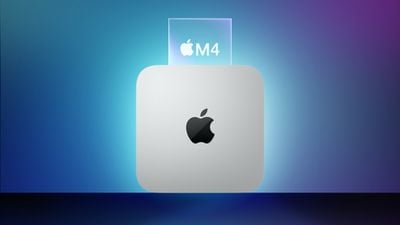













Apple is planning to refresh the entire Mac lineup with updated M4 chips starting in late 2024 and continuing into 2025, and that will include a new M4 chip for Apple's mid-tier desktop machine, the Mac Studio.
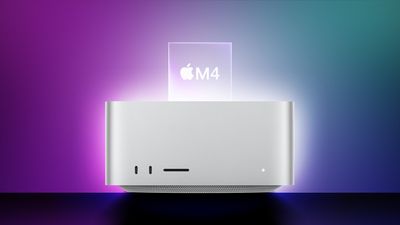
M4 Chip Rumors
Apple has a lineup of M4 chips in development, including the standard M4, the M4 Pro and M4 Max, and a higher-end version that's codenamed "Hidra." This higher-end chip could be an "Ultra" version that's equivalent to the M2 Ultra, or it might even be something even more powerful.
With the M2 lineup, the M2 Ultra is a chip that is in fact two M2 Max chips linked together. There is no M3 Ultra at this time, but the architecture of the M3 Max chip has led to speculation that future Ultra chips might be standalone chips rather than constructed from two Max dies.
The M3 Max seems to lack the UltraFusion interconnect that allowed the M2 Max chips to function as an Ultra. Because that's missing, it's likely the Ultra chip would have dedicated development with customizations for heavy workloads. Apple could tweak the number of performance and efficiency cores to focus on power, and add more GPU cores.
Current Mac Studio machines use M2 Max and M2 Ultra chips, so we can expect the M4 models to be equipped with M4 Max and M4 Ultra (or its equivalent) chips. Aside from the Mac Pro, the Mac Studio is the only Apple machine that uses "Ultra" chips.
The Mac Studio is designed for Mac users who have system intensive workflows that require advanced compute and graphics capabilities. There isn't a lot of differentiation between the Mac Studio and Mac Pro as of right now, so Apple may be planning for a more powerful M4 Ultra variant for the Mac Pro.
Apple is going all-in on artificial intelligence across its product lineup in the coming months, so the M4 is expected to have a focus on boosting AI and machine learning performance. Rumors suggest there will be an updated Neural Engine with a greater number of cores to handle AI tasks.
Memory Updates
The next Mac Studio and Mac Pro could support as much as 500GB of Unified Memory, up from the current 192GB maximum.
What About the M3?
With Apple planning to refresh the Mac Studio with M4 chips in 2025, it's not entirely clear as of yet if there will be an M3 refresh this year.
The iMac, MacBook Pro, and MacBook Air lines have been updated with M3 chips, but the Mac mini, Mac Studio, and Mac Pro are still using M2 chips. With the M4 refresh already planned, Apple could skip the M3 update for its desktop machines, but it's also possible we'll get an M3 refresh around the middle of the year and a second M4 refresh next year, which would put a year between each update.
Apple is testing a version of the Mac Studio with an M3 processor, so an update this year and then a second update next year is plausible.
Design Changes
The Mac Studio hasn't had a design update since it was first launched in March 2022, but it hasn't really existed long enough to need a refresh. Apple tends to wait several years before making major changes to Mac hardware, and we are not expecting the Mac Studio to get a refreshed look in the near future.
It will likely be closer to 2026 or 2027 before Apple considers updating the design, though it could be even longer. The Mac mini has not seen notable design changes since 2010.
Release Date
According to Bloomberg's Mark Gurman, the Mac Studio with M4 chip is expected to be released in mid-2025, which would suggest a possible introduction at the 2025 Worldwide Developers Conference.
 Note: MacRumors is an affiliate partner with Amazon. When you click a link and make a purchase, we may receive a small payment, which helps us keep the site running.